The Hidden Risks of Direct ERP Access
In the race to digitize sales, many small-to-medium enterprises (SMEs) face a critical architectural crossroads. To provide instant pricing to customers, the temptation is to "plug" a public-facing web form directly into the Enterprise Resource Planning (ERP) system. On the surface, it seems efficient: a customer enters their requirements, and the ERP spits out a price.
However, as a senior cybersecurity consultant and system architect, I have seen this shortcut lead to catastrophic failures—ranging from data breaches that cripple reputations to system crashes during peak sales periods.
The truth is that your ERP is the "brain" of your business. It contains your financial records, supplier data, payroll, and proprietary logic. Exposing it directly to the public internet is the digital equivalent of putting your company’s main vault in the middle of the sidewalk.
To protect your business while maintaining efficiency, you must decouple your front-end quotation system from your back-end ERP. Here is why a dedicated web-based quotation system is a non-negotiable requirement for modern enterprise security and performance.
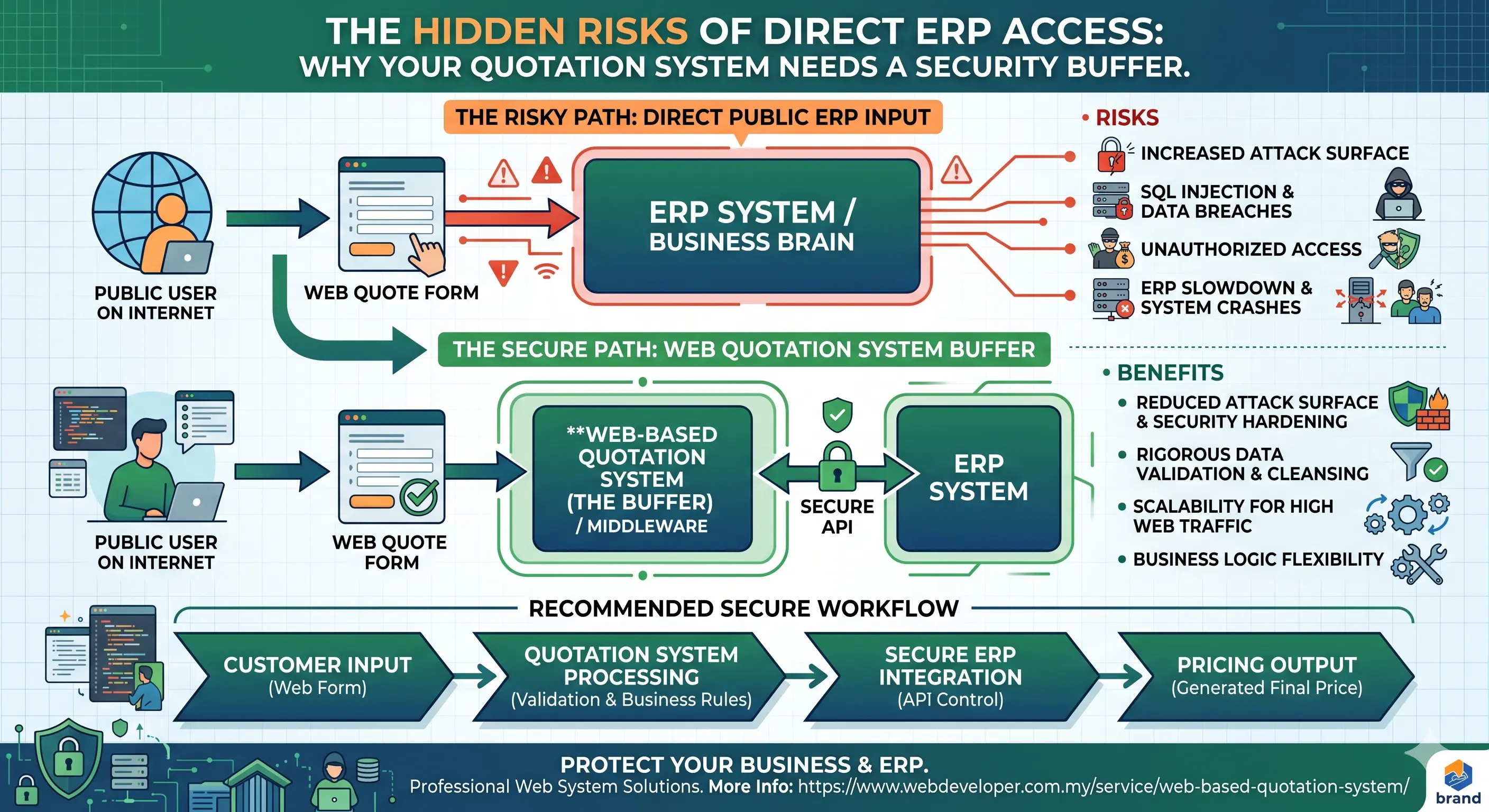
1. Closing the Attack Surface: Why Direct ERP Exposure is Dangerous
Every time you connect a system to the public internet, you create an "attack surface." If your ERP is directly processing public input, you are inviting every bot, hacker, and malicious actor to interact with your most sensitive database.
The Threat of Unauthorized Access
ERP systems are designed for internal users. They often lack the hardened, multi-layered security protocols required for public-facing web applications. By allowing direct input, you risk:
SQL Injections: Malicious code entered into a quote form that "tricks" your ERP database into revealing hidden records.
Data Breaches: Once a hacker finds a vulnerability in the public-facing port of your ERP, they may gain lateral movement, allowing them to access your financial statements or customer PII (Personally Identifiable Information).
DDoS Attacks: If your ERP is busy processing thousands of "fake" quote requests from a botnet, your internal staff won't be able to process invoices or manage inventory.
2. System Architecture Best Practices: The Power of Decoupling
In enterprise architecture, "decoupling" refers to separating the user interface (the frontend) from the core business logic (the backend).
A web-based quotation system acts as a security buffer or a "Demilitarized Zone" (DMZ). When a user requests a quote, they are interacting with a lightweight, hardened web application—not your ERP. The quotation system collects the data, cleans it, and only then passes a sanitized request to the ERP via a secure API (Application Programming Interface).
This ensures that even if the quotation system were to be compromised, the attacker is still one major step away from your core business data.
3. Data Validation: The Gatekeeper Role
Direct input into an ERP assumes that the data provided is "clean." In the real world, users make mistakes, and bots submit gibberish.
Without a dedicated web-based quotation system serving as a middleware, "dirty data" flows directly into your ERP. This can lead to:
Corrupted database entries.
Incorrect pricing outputs that you might be legally bound to honor.
System errors that require expensive IT hours to fix.
A standalone quotation system allows for rigorous validation logic. It checks for valid email formats, realistic quantity requests, and prevents "edge case" inputs that could crash an older ERP system. It ensures that only "perfect" data ever reaches your internal records.
4. Performance and Scalability: ERPs are Not Web Servers
ERPs are "heavy" applications. They are designed for complex calculations, deep database queries, and long-term storage. They are not designed to handle high volumes of concurrent web traffic.
Imagine a marketing campaign goes viral. You have 5,000 people requesting a quote at the same moment.
The Direct Approach: Your ERP attempts to handle 5,000 simultaneous sessions. The system slows to a crawl. Your warehouse team can’t print shipping labels, and your accounting team can’t close the month.
The Decoupled Approach: Your lightweight web-based quotation system handles the 5,000 users with ease. It queues the requests and feeds them to the ERP at a manageable pace. Your internal operations remain fast and unaffected.
5. Business Logic Flexibility and Customization
Your ERP is often rigid. Changing pricing rules or adding a "seasonal discount" slider might require a specialized ERP consultant and weeks of development.
A separate web-based quotation system gives you the agility to change your "front-of-house" logic without touching the "back-of-house" code.
Custom Equipment Rules: If you sell complex machinery, the web system can handle the "if-this-then-that" logic of choosing parts.
A/B Testing: You can test different pricing layouts or promotional bundles on the web form to see what converts best, without risking the integrity of your ERP's master price list.
6. Compliance and Data Privacy (GDPR & PDPA)
With regulations like the PDPA in Malaysia and GDPR in Europe, how you handle user data is a legal liability.
By separating the quotation system, you can implement specific data retention policies for leads that are different from those for actual customers. You can store "quote-only" data in a temporary, encrypted web database and only move it to the "permanent" ERP once the lead becomes a paying customer. This minimizes the volume of sensitive data you hold in your primary system, reducing your overall compliance risk.
7. The Recommended Workflow: A Secure Path to Pricing
To achieve the best balance of user experience and enterprise security, we recommend the following workflow:
User Input: The customer fills out a high-performance, user-friendly form on your website.
Web Quotation System: The system validates the data, filters out bots, and applies front-end pricing logic.
Processing/Validation: The middleware checks the request against current inventory or availability.
Secure ERP Integration: A filtered, encrypted request is sent via API to the ERP.
Pricing Output: The ERP generates the final calculation and sends it back to the Web System, which presents it beautifully to the customer.
Conclusion
In the modern threat landscape, convenience should never come at the cost of security. While it may seem simpler to link your ERP directly to the web, the risks of data breaches, system instability, and poor performance are far too high for any growing business to ignore.
By investing in a dedicated, decoupled web-based quotation system, you are not just buying a tool—you are building a fortress around your company’s most valuable digital assets. You gain the flexibility to innovate, the power to scale, and the peace of mind that your "business brain" is safe from prying eyes.
Secure Your Business with a Professional Quotation System
Don't leave your enterprise data exposed. Transition to a professional, secure, and scalable architecture that protects your bottom line while delighting your customers.
Are you ready to modernize your sales process without compromising security? Explore our to see how we can build a secure, high-performance bridge between your customers and your ERP.


Comments
Post a Comment