How Google Personalizes Search Results & What It Means for SEO | SEOWebMalaysia
Here is something that surprises many business owners the first time they hear it.
When you open Google, search for your own business or service keyword, and see yourself ranking on the first page that result is not what your customer necessarily sees.
Your customer, searching the same keyword from a different location, a different device, with a different browsing history, may see a completely different set of results in a different order, with different content types prioritized.
This is not a glitch. It is by design. Google personalizes search results for every user based on a growing set of signals from location and device type to, increasingly, data from Gmail and Google Photos.
For Malaysian business owners and marketing teams managing SEO, this changes how you should think about rankings, content strategy, and visibility in 2026.
This article explains how search personalization works, what Google's newest "Personal Intelligence" feature actually does, and what practical steps your business should take to remain visible in both traditional search results and AI-generated answers.
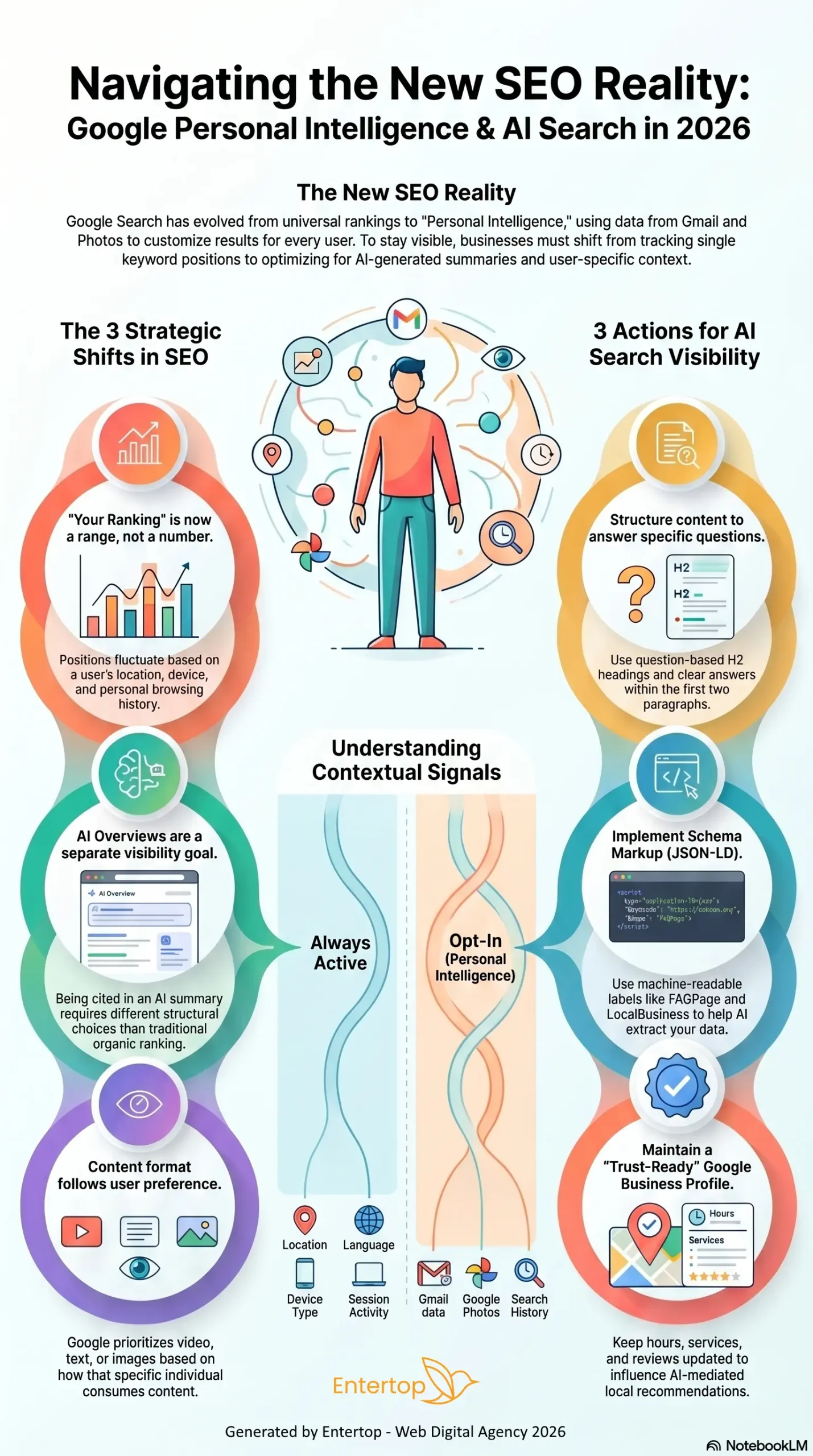
What Is Google Search Personalization? And What Is Always Active?
Before getting into strategy, it helps to understand what Google actually does and what it does not do when it personalizes results.
Personalization signals that are always active (even for signed-out users)
Even if a user has never logged into a Google account, the following signals are always used to shape results:
Location. Google uses the user's approximate location for any query where geography matters. This includes obvious examples like "restaurant near me," but also less obvious ones a user in Petaling Jaya and a user in Johor Bahru may see different local business results for the exact same general service keyword.
Language. Results are matched to the user's language settings, which affects which sites surface and in what order.
Device type. Mobile and desktop results can differ both in layout and in content type prioritization. Mobile results also surface relevant app store links that desktop results do not.
Recent activity within the same session. If a user clicks back to the results page quickly after visiting your site, Google interprets that as a dissatisfied click and may rerank other results above you for the remainder of that session.
Deeper personalization for signed-in users (opt-in required)
For users who are signed in and have enabled personalized recommendations, Google goes further:
Search history and browsing patterns influence the order in which results are ranked. A user who regularly reads technical guides will see different content formats prioritized than someone who primarily watches YouTube videos. (Yes a heavy video viewer may see video content blocks ranked above text websites for a query you wrote a full article for.)
Google account activity across other Google services contributes contextual signals to what Google predicts will be most relevant.
The newest layer: Google Personal Intelligence
In 2026, Google introduced a feature called Personal Intelligence an expansion of its AI Mode that connects personal data from Google Workspace and Google Photos directly into the search experience.
When a user enables this feature:
Gmail data including past purchases, booking confirmations, travel itineraries, and reservations can be referenced by Google's AI when answering new search queries.
Google Photos data including images, hobbies, and brand preferences inferred from visual content can inform recommendations across Search, Maps, Shopping, and more.
This connected data feeds into Google's AI Mode, which currently has over one billion monthly users globally, with queries more than doubling every quarter.
A practical example: If a user has a hotel booking confirmation in their Gmail from a stay in Penang, Google's AI may factor that travel history into what restaurants, tour operators, or travel-related businesses it surfaces when that user later searches for related topics even weeks later.
Important note for Malaysian businesses: While Personal Intelligence is expanding to nearly 200 countries, certain features particularly Google Photos integration are not uniformly available across all regions. Availability in Malaysia for specific features should be verified against Google's latest settings documentation. However, the Gmail and browsing history components are widely active for signed-in users.
Can Users Turn Personalization Off?
Yes and Google makes this reasonably transparent.
Users can see a small notification at the bottom of personalized search results indicating that results have been personalized. A "Try without" link allows them to view a non-personalized version of their current query without permanently changing their account settings.
Users can also disable "Personalized Recommendations" in their account settings or toggle off "Search customization" when signed out.
However and this is the important part even with personalization fully disabled, location, language, and device type continue to shape results. These contextual signals are not considered personalization; they are considered relevance factors. There is no such thing as a completely neutral, universal search result.
What This Means for Your SEO: The Three Shifts
Understanding personalization is not just an interesting technical footnote. It has direct implications for how you measure SEO performance and how you build content.
Shift 1: "Your ranking" is now a range, not a number
When someone asks "what position does my website rank for [keyword]," the honest answer in 2026 is: it depends on who is searching.
A single keyword can generate different result orders for different users based on their location, device, browsing history, and personal context. Tracking one ranking number in isolation without understanding the query context can lead to misplaced confidence or unnecessary alarm.
What to do: Use Google Search Console as your primary ranking reference. It shows average position across real user queries over time, which gives a more representative picture than a single spot-check from your own browser. Pay attention to impression data alongside click data large gaps between the two often indicate that your result is being seen but not clicked, which is a content or title problem, not a ranking problem.
Shift 2: AI Overviews are a separate visibility goal from traditional rankings
For many informational queries, Google now places an AI-generated summary at the very top of the results page above all organic links. This is called an AI Overview.
Being cited inside an AI Overview is a different achievement from ranking number one in traditional organic results. Both forms of visibility matter. But they require different content approaches.
A ranked link tells Google: this page is relevant and authoritative for this query.
An AI Overview citation tells Google's AI: this page contains a clear, direct, trustworthy answer that I can extract and present to a user.
What to do: Write content that answers the user's specific question clearly within the first 100 to 150 words. Use question-based headings. Include FAQ sections. These structural choices make your content more extractable by AI systems, not just more readable by humans.
Shift 3: Video and content format preferences affect what users see
Users who primarily consume video content may see video results prioritized above text articles even for queries where you have a well-written, well-ranked blog post.
This is not a penalty on your content. It is Google responding to that individual user's consumption patterns. But it does mean that a content strategy built entirely around text articles may be invisible to a meaningful segment of your audience.
What to do: This does not mean you need to produce videos for every topic. It does mean being aware that content format diversity text, video, infographics, FAQ-structured pages gives you more surface area across different user contexts.
What Should Malaysian Businesses Do? Five Practical Actions
These actions apply to most Malaysian business websites regardless of industry or size.
1. Stop measuring SEO success by one keyword position
Replace "where do we rank for [keyword]" with more meaningful questions:
How many total clicks are we receiving from organic search this month compared to last?
Which specific queries are driving those clicks?
Are there queries with high impressions but low clicks where our listing is being seen but not chosen?
Google Search Console answers all three of these. If you are not checking it regularly, you are managing SEO without the most important instrument on your dashboard.
2. Structure content to answer questions, not just target keywords
The shift from keyword matching to intent matching is one of the most consequential changes in how search works. Google's AI and its AI Overviews favor content that directly and clearly answers a specific question.
In practice this means:
Open each article or service page with a direct, plain-language answer to the core question the page is meant to address. Do this within the first two paragraphs.
Use question-based H2 headings throughout. "What is [topic]?" and "How does [process] work?" are both better headings than generic labels like "Overview" or "Details."
Add FAQ sections to service pages and key articles. These are among the most directly extractable content formats for AI-generated answers.
3. Make your website readable by machines, not just humans
Structured data specifically JSON-LD schema markup is a way of embedding machine-readable labels directly into your web pages. It tells search engines and AI systems exactly what type of content a page contains.
For most Malaysian business websites, the minimum useful implementation is:
Organization or LocalBusiness schema on the homepage (your name, address, phone, service area)
FAQPage schema on pages with FAQ sections
Article schema on blog posts and guides
This does not change how your pages look to visitors. It changes how clearly search engines can interpret and cite your content.
4. Treat your Google Business Profile as a trust asset, not a one-time setup
Location signals are always active in Google Search, regardless of personalization settings. For local service businesses and most Malaysian SMEs are effectively local or regional service businesses Google Business Profile is a foundational ranking signal.
More importantly, as Google's agentic capabilities expand, accurate GBP data is increasingly what AI systems use to represent your business in AI-generated recommendations.
Check the following on your GBP at least quarterly:
Business category (does it accurately reflect your core service?)
Operating hours (are they current, including public holiday adjustments?)
Services listed (are all key service areas named explicitly?)
Recent reviews (are you responding to them?)
Photos (are they updated and representative?)
An outdated or incomplete GBP profile is not just a minor gap it is a signal that the business information cannot be trusted, which directly affects whether Google surfaces you in AI-mediated recommendations.
5. Build brand presence in channels that AI can access and cite
Personal Intelligence means that brand mentions in a user's Gmail booking confirmations, newsletters, service receipts can influence how Google's AI perceives and recommends your brand to that user in future searches.
This is not a reason to spam your email list. It is a reason to ensure that every customer-facing email communication is clear, professional, and consistently branded. A booking confirmation that uses your full business name, service description, and website URL creates a brand data point inside the Gmail ecosystem.
Beyond email:
LinkedIn articles and structured blog content are more likely to be cited as authority sources in AI-generated answers than generic marketing copy.
Third-party mentions reviews, press coverage, industry directory listings contribute to the entity authority signals that AI systems use to determine which businesses to recommend.
Consistent NAP (Name, Address, Phone) across your website, GBP, and directories removes ambiguity for both search engines and AI systems trying to identify and describe your business accurately.
What This Does Not Mean
Before this becomes a source of unnecessary concern, a few clarifications:
It does not mean SEO is becoming irrelevant. Google still indexes the web to power AI Overviews. Being crawlable, fast, technically sound, and well-structured still matters and forms the foundation of everything above.
It does not mean your existing rankings are worthless. Rankings remain important for navigational queries (someone searching your business name) and transactional queries (someone searching for a specific service ready to contact or buy). The impact of personalization is most significant for informational and research-stage queries.
It does not mean you need to rebuild your website immediately. Most of what makes a website rank well under traditional SEO clear content, fast load times, mobile-friendly design, accurate information also makes it a stronger candidate for AI citation. The foundations are the same. The goal extends slightly beyond rankings alone.
AI and Personalized Search Readiness: A Quick Checklist
Use this to identify where your website currently stands.
Content
Does each key page answer one specific user question clearly within the first two paragraphs?
Do your service pages and articles use question-based H2 headings?
Do your key pages include FAQ sections?
Technical
Is FAQ schema (JSON-LD) implemented on relevant pages?
Is your website fully crawlable? (Check Google Search Console for Coverage errors)
Does your site load within 3 seconds on mobile?
Brand Authority
Is your Google Business Profile accurate and updated within the last 90 days?
Are you actively collecting and responding to Google reviews?
Is your business name, address, and phone number consistent across your website and all online directories?
Content Depth
Do you have at least one comprehensive, well-structured article on each of your core service topics?
Are your articles written with specific information, practical guidance, and real examples rather than generic marketing language?
Does your most important content avoid being locked inside image carousels, sliders, or JavaScript-rendered elements that crawlers may not read?
Frequently Asked Questions
Does Google personalize search results for everyone? Google applies some level of contextual adjustment to all users including location, language, and device type even for signed-out users. Deeper personalization based on search history and account activity applies to signed-in users. Google's Personal Intelligence feature, which connects Gmail and Photos data to AI Mode, requires explicit opt-in and applies only to personal Google accounts where users have enabled these settings.
How does Google Personal Intelligence affect search results? Personal Intelligence allows Google's AI Mode to reference data from a user's connected apps currently Gmail, with Calendar and Drive planned when generating personalized search answers. This means a user's past purchases, bookings, or email history can influence what businesses and services Google recommends to them in future queries.
Can I see what my website's search results look like without personalization? You can view a version of your own search results without personalization by using the "Try without" link that appears at the bottom of personalized result pages. However, location, language, and device type will still influence what you see these are contextual signals, not personalization.
Does search personalization affect my business's SEO ranking? Yes, in the sense that different users may see your website in different positions depending on their personal context. However, the core quality signals that determine whether your website is ranked at all content quality, authority, technical health, relevance remain consistent across users. Personalization affects ordering and format prioritization, not whether Google considers your site trustworthy.
What is the difference between traditional SEO and AI search optimization? Traditional SEO focuses on earning ranked positions in Google's link-based results. AI search optimization (sometimes called AEO or GEO) focuses on making your content clear, structured, and authoritative enough to be cited within AI-generated summaries and answers. Both are now relevant goals. The technical foundations overlap significantly good SEO supports good AI search visibility.
How do I check if Google is showing an AI Overview for my target keywords? Search for your target keywords in an incognito browser window (to reduce personal personalization) and observe whether an AI-generated summary appears above the organic results. You can also check Google Search Console for queries with high impressions but lower-than-expected click-through rates this pattern often indicates an AI Overview is answering the query before users reach your organic listing.
Recommended Next Step
Understanding how Google personalizes results is the first step. Building a content and SEO strategy that performs well across both traditional rankings and AI-generated search is where the real work begins.
If you want to understand how your website currently performs in both traditional Google search and AI-generated results and what gaps exist in your content structure, technical setup, or brand authority Entertop's SEO and AI search visibility team can help you map the issues and build a practical plan.
>
If your website needs a broader technical review covering speed, security, structure, and search performance the Entertop team supports Malaysian businesses with full website assessment and long-term digital maintenance.
>